What Are Single Vision Lenses?
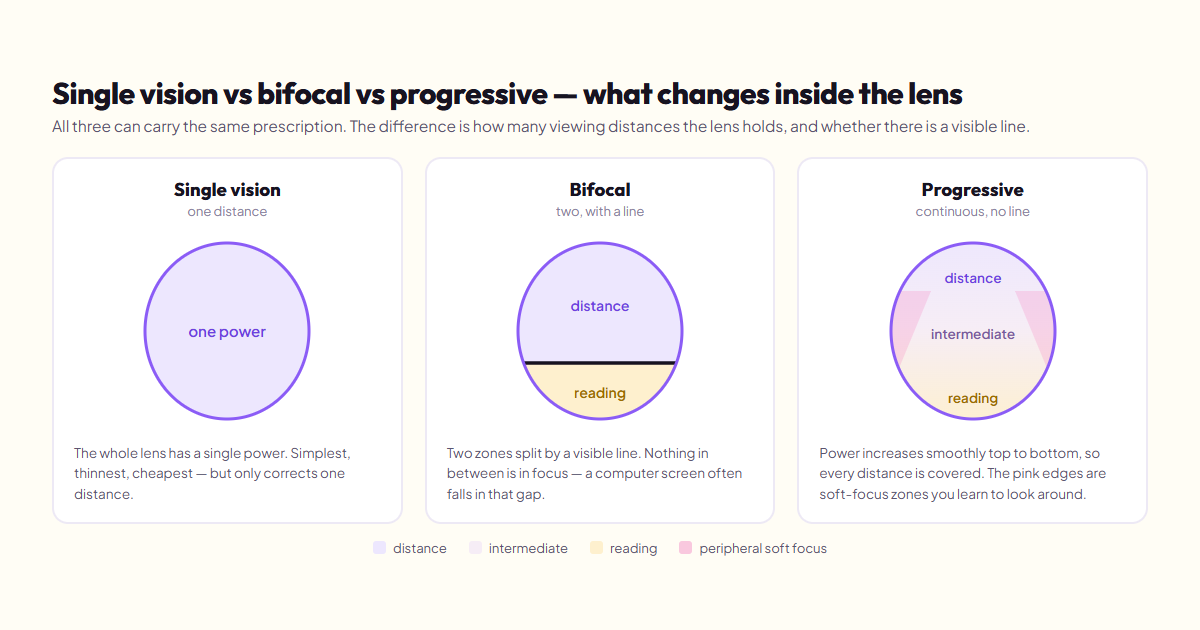
Single vision lenses are eyeglass lenses ground to a single, uniform prescription power across the entire surface. Unlike progressive lenses or bifocals that contain multiple zones for different distances, a single vision lens provides correction at one focal distance only.
They are the most widely prescribed lens type globally. If your optometrist writes a prescription for distance glasses or reading glasses without an "ADD" power, you're getting single vision lenses.
Single vision lenses correct:
- Myopia (nearsightedness) — Concave lens bends light outward so distant objects focus correctly on the retina
- Hyperopia (farsightedness) — Convex lens bends light inward to help the eye focus on nearby objects
- Astigmatism — Cylindrical correction compensates for an irregularly shaped cornea
Understanding the terminology helps you make informed decisions when shopping for glasses and communicating with your eye care provider. Many people feel overwhelmed by the technical language used in optical stores — but the concepts are actually straightforward once you know what each term means. Don't hesitate to ask your optician to explain anything you're unsure about. A good optician takes the time to educate rather than just sell.
At Charm Optical in Edmonton, the staff walks every patient through their options in plain language — no jargon, no pressure. Whether you're buying your first pair of glasses or upgrading to progressive lenses, they explain what each choice means for your vision and your budget. Book an eye exam to start with an up-to-date prescription, then take your time choosing frames and lenses with expert guidance.
Single Vision vs. Progressive vs. Bifocal Lenses
| Feature | Single Vision | Progressive | Bifocal |
|---|---|---|---|
| Correction zones | One | Three (distance, intermediate, near) | Two (distance, near) |
| Visible line | No | No | Yes |
| Best for | Under 40, single correction need | Over 40, all-distance correction | Over 40, budget-friendly multifocal |
| Cost (Canada) | $80 — $250 | $200 — $600+ | $100 — $250 |
| Adjustment period | None to minimal | 1-2 weeks | A few days |
If you're under 40 and only need distance or reading correction, single vision lenses are almost always the right choice. Once presbyopia begins (typically age 40-45), your optometrist may recommend upgrading to progressive lenses or bifocals.
When comparing options, consider your daily routine and visual priorities rather than just price. The "best" choice is the one that matches how you actually use your eyes throughout the day. Someone who works on a computer for 8 hours has very different needs than someone who primarily drives or reads. An honest conversation with your optometrist about your daily visual demands will point you toward the right option far more effectively than online reviews.
Keep in mind that you're not locked into one choice forever. Many people own multiple pairs for different situations — dedicated computer glasses for the office, progressives for daily wear, and prescription sunglasses for driving. Charm Optical carries 500+ frames across every style and price point, making it easy to build a collection that covers all your visual needs. Their opticians can advise which lens types pair best with each frame style. Same-day glasses are available for many single vision prescriptions.
How Much Do Single Vision Lenses Cost in Canada?
Single vision lenses are the most affordable prescription lens option. Here's what to expect:
- Basic (CR-39 plastic, 1.50 index): $80 — $120
- Mid-range (1.60 index, anti-reflective coating): $120 — $180
- Premium (1.67/1.74 high index, AR + blue light): $180 — $250+
Most employer insurance plans in Alberta cover single vision lenses fully within their optical benefit allocation. Stores like Charm Optical in Edmonton can often produce single vision glasses same-day, and direct-bill most insurance providers.
Pricing varies significantly depending on where you buy and what lens features you choose. In Canada, the total cost of a complete pair of glasses (frame + lenses) typically breaks down as follows: budget options start at $150-$250 for basic frames with standard single vision lenses. Mid-range options with anti-reflective coating and a name-brand frame run $300-$500. Premium designer frames with progressive or high-index lenses can reach $600-$900+. The biggest variable is usually the lens — a basic single vision lens costs far less than a digital freeform progressive with premium coatings.
Insurance makes a significant difference. Most employer health plans in Alberta cover $200-$500 toward glasses every 1-2 years. Charm Optical direct-bills most Alberta insurance providers — Alberta Blue Cross, Canada Life, Desjardins, and more — so you only pay the difference at the counter. No paperwork, no reimbursement wait. Book an eye exam to get your prescription checked and learn exactly what your plan covers before you shop.
When to Choose Single Vision Over Multifocal
Single vision lenses are the right choice when:
- You only need correction for one distance (far or near, not both)
- You're under 40 and haven't developed presbyopia yet
- You want dedicated computer glasses at a specific arm-length distance
- You want the widest possible field of clear vision at one distance
Some people over 40 choose to have two pairs of single vision glasses — one for distance and one for reading — rather than switching to progressives. This gives a wider field of view at each distance but requires switching between pairs. An eye exam will determine which approach makes sense for your prescription.
If you're experiencing any of these signs regularly, it's worth getting a professional assessment rather than guessing. Many vision problems develop gradually — your brain compensates for declining vision so effectively that you may not notice the change until it's significant. A comprehensive eye exam can detect issues that self-assessment misses, including early signs of conditions like glaucoma and macular degeneration that have no symptoms in their early stages.
The Canadian Association of Optometrists recommends eye exams every 1-2 years for adults. Children should be examined annually since vision problems can significantly impact learning and development. In Alberta, children under 18 receive coverage through Alberta Health. Adults with diabetes or a family history of eye disease should also get annual exams. Book an appointment at Charm Optical — they accept most Alberta insurance providers through direct billing.
Why Good Eyewear Matters
Your eyes are one of the most important tools you have, and they deserve proper care and correction. The technology behind modern eyewear has advanced remarkably in recent years — from digital freeform progressive lenses that customize the optics to your exact wearing position, to lightweight titanium frames that weigh less than a coin, to anti-reflective coatings that virtually eliminate glare. Understanding these options empowers you to make better choices about your eye health and get glasses that genuinely improve your quality of life rather than just meeting a basic need.
Regular eye exams are the foundation of good vision care. The Canadian Association of Optometrists recommends exams every one to two years for adults and annually for children, seniors over 65, and anyone with diabetes or a family history of eye disease. A comprehensive exam does far more than measure your prescription — your optometrist checks the health of your retina, optic nerve, and blood vessels, catching conditions like glaucoma and macular degeneration in their earliest stages. Many serious eye conditions have no noticeable symptoms until significant damage has occurred, making preventive exams essential.
The Bottom Line
The best next step is always a professional eye exam. Your optometrist can evaluate your specific needs and recommend the right combination of lenses, coatings, and frames for your lifestyle and budget. In Alberta, most employer insurance plans cover comprehensive eye exams, and children under 18 and adults over 65 receive coverage through Alberta Health.
Charm Optical at 5035 Ellerslie Rd SW in South Edmonton offers thorough eye exams with experienced optometrists, a selection of over 500 designer frames from brands like Ray-Ban, Oakley, and Versace, and same-day glasses for many prescription types. They offer direct insurance billing for most Alberta providers, so you only pay the difference at the counter — no upfront costs and no claim forms to submit afterwards.
Whether you're buying your first pair of glasses, upgrading to progressive lenses, or just need an adjustment on your current frames, having a trusted local optician makes the entire process smoother. Book an appointment online — most appointments are available within a few days, and walk-ins are welcome for adjustments and frame browsing.
Need Single Vision Lenses?
Charm Optical in South Edmonton offers same-day single vision glasses with direct insurance billing for most Alberta providers.
Visit Charm OpticalFrequently Asked Questions
Sources & Further Reading
- World Health Organization — Vision — Global vision impairment statistics and prevention
- The Vision Council — Optical industry research and consumer education
- National Eye Institute — Eye health and vision correction resources
- American Academy of Ophthalmology — EyeSmart — Peer-reviewed eye health information