Around age 40, most people notice a frustrating change: reading small print becomes harder. Phone screens need to be pushed further away. Restaurant menus require squinting. This condition — presbyopia — is a normal part of aging, and it's the reason millions of Canadians need multifocal lenses.
The two main options are bifocal lenses and progressive lenses. Both solve the same problem, but in fundamentally different ways. This guide explains how each works, compares their advantages and disadvantages, and helps you decide which is right for your eyes, your lifestyle, and your budget.
What Is Presbyopia?
Presbyopia is the gradual loss of your eye's ability to focus on nearby objects. It's caused by the natural hardening of the crystalline lens inside your eye, which becomes less flexible with age. This has nothing to do with your cornea (which is what LASIK corrects) — it's an internal change that happens to virtually everyone.
Symptoms typically begin between ages 40 and 45 and include:
- Difficulty reading small text, especially in low light
- Holding reading material at arm's length
- Eye strain or headaches after close work
- Trouble focusing on your phone screen
If you already wear glasses for distance vision and are now experiencing these symptoms, you need multifocal lenses — either bifocal or progressive. If you don't currently wear glasses, you might start with simple reading glasses, but as presbyopia progresses, multifocals become more practical. A comprehensive eye exam will determine the exact add power you need.
How Bifocal Lenses Work
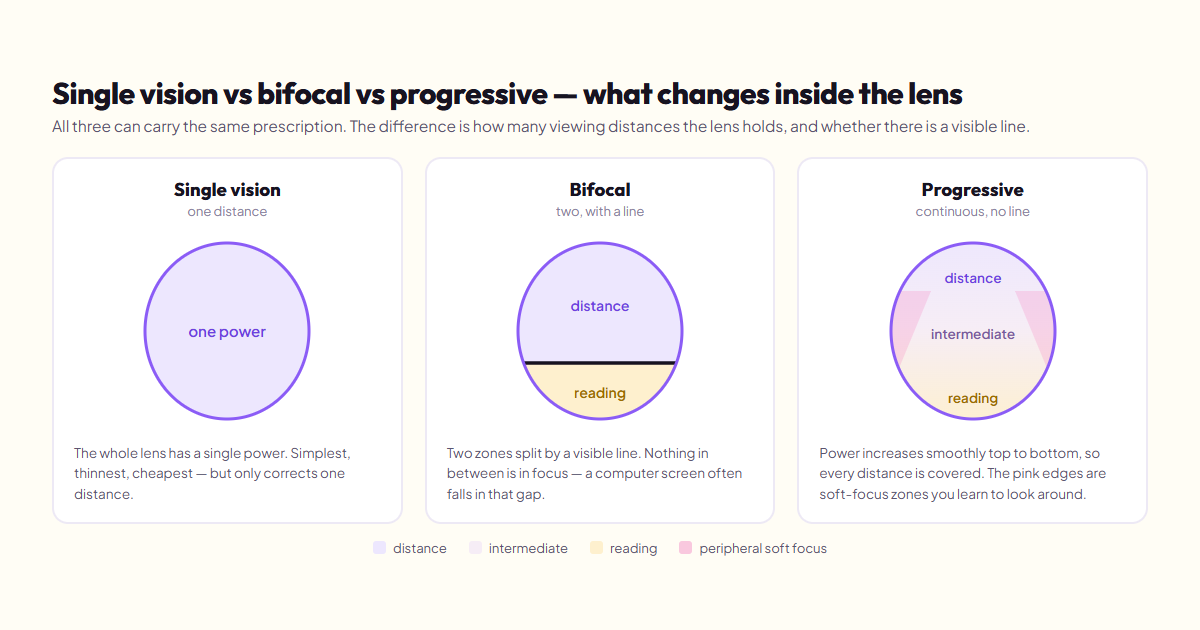
Bifocal lenses are the original multifocal solution, invented by Benjamin Franklin in the 1780s. The concept is simple: two different prescriptions in one lens, separated by a visible line.
- Upper segment — Your distance prescription (for driving, walking, seeing across a room)
- Lower segment — Your near/reading prescription (for books, phone, close work)
The dividing line between these zones is visible on the lens as a distinct half-moon or D-shaped segment in the lower portion. When you want to see far, you look through the top. When you want to read, you lower your eyes to look through the bottom.
The transition between zones is immediate — you're either looking through the distance portion or the near portion, with no gradual change in between.
Types of Bifocal Lenses
- Flat-top (D-segment) — The most common type. A D-shaped near segment in the lower half of the lens. Available in 25mm, 28mm, and 35mm segment widths.
- Round segment — A circular near zone instead of a D-shape. Less common today.
- Executive (Franklin) bifocal — The line extends across the entire width of the lens, giving maximum near-vision area. Used when extensive near work is needed.
How Progressive Lenses Work
Progressive lenses (also called no-line bifocals, varifocals, or multifocal lenses) provide the same distance and near correction as bifocals, but with a smooth, continuous gradient of prescription power from top to bottom — and no visible line.
A progressive lens has three functional zones:
- Distance zone (top) — For driving, walking, and seeing at a distance
- Intermediate zone (middle) — For computer screens, dashboard gauges, and arm's-length tasks
- Near zone (bottom) — For reading, phone use, and close-up work
The transition between these zones is gradual and invisible. As your eyes move down the lens, the prescription smoothly shifts from distance to intermediate to near. This mimics how natural, young eyes focus at different distances — a seamless, continuous range of vision.
The Trade-Off of Progressives
To create this smooth transition, progressive lenses have areas of soft distortion in the lower-left and lower-right periphery. This is an inherent optical limitation — you can't create a smooth power gradient on a flat surface without some peripheral blur. Higher-quality (and more expensive) progressive lens designs minimize this distortion, but it can never be completely eliminated.
Bifocal vs Progressive: Side-by-Side Comparison
| Feature | Bifocal Lenses | Progressive Lenses |
|---|---|---|
| Vision zones | 2 (distance + near) | 3 (distance + intermediate + near) |
| Visible line | Yes | No |
| Intermediate vision | Not included | Included |
| Peripheral distortion | Minimal | Moderate (varies by lens quality) |
| Adjustment period | Short (1-3 days) | Longer (1-2 weeks) |
| Aesthetics | Visible line dates the look | Looks like regular glasses |
| Computer use | Poor (no intermediate zone) | Good |
| Reading area width | Wide (full segment width) | Narrower (progressive channel) |
| Cost (lenses only) | $80 — $150 | $150 — $400+ |
| Best for | Extended reading, budget-conscious | All-day wear, computer work, aesthetics |
Advantages of Bifocal Lenses
Wider Reading Area
The near segment in a bifocal lens is a defined zone with a consistent prescription across its width. Progressive lenses, by contrast, have a narrower "corridor" of clear near vision. If you spend hours reading books, sewing, or doing detailed close work, bifocals offer a wider usable near zone with no peripheral blur.
Easier Adjustment
Most people adapt to bifocals within 1-3 days. The distinct zones are intuitive — look up for distance, look down for near. Progressive lenses typically take 1-2 weeks, and some people (roughly 10-15%) never fully adapt, especially to the peripheral distortion.
Lower Cost
Bifocal lenses cost significantly less than progressives — typically $80-150 for the lenses compared to $150-400+ for progressives. If budget is a primary concern, bifocals provide reliable multifocal vision at a lower price point. Stores like Charm Optical in Edmonton offer affordable lens packages for both types.
Consistent Optics
Each zone in a bifocal lens has uniform optical quality — there's no gradual transition area with compromised clarity. For professions that require precise vision (watchmakers, surgeons, lab technicians), this consistency can be advantageous.
Advantages of Progressive Lenses
Intermediate Vision
This is the single biggest advantage of progressives over bifocals. Bifocals give you two focal points: far and near. Progressives add a crucial third: intermediate distance (approximately 50-100cm), which is exactly where your computer screen, car dashboard, grocery shelf labels, and cooking surfaces sit. In 2026, with most people spending hours daily on computers, the intermediate zone isn't a luxury — it's essential.
No Visible Line
Progressive lenses look identical to single-vision lenses. There's no visible line advertising that you wear multifocals. For many people, this aesthetic advantage alone justifies the cost difference. The visible bifocal line carries an "aging" stigma that progressives avoid entirely.
Natural Vision Transition
Instead of an abrupt jump between distance and near (which can cause a disconcerting "image jump" effect in bifocals), progressives provide a smooth, natural transition. When you lower your gaze from the road to the dashboard to your phone, the focus changes gradually — similar to how young, presbyopia-free eyes work.
One Pair for Everything
Progressives are true all-purpose lenses. You can drive, work at a computer, check your phone, and read a book — all with one pair of glasses. Bifocal wearers often need a separate pair of computer glasses for intermediate distance, effectively paying for two pairs instead of one.
The Adjustment Period: What to Expect
Adjusting to Bifocals
Bifocal adjustment is usually straightforward. The main thing to get used to is the "image jump" — the abrupt shift in focus when your eyes cross the line between the distance and near zones. Most people adapt within a few days. Tips:
- Move your eyes, not your head, to shift between zones
- When going down stairs, tilt your head slightly down so you're looking through the distance portion
- Wear them consistently from day one
Adjusting to Progressives
Progressive lens adaptation takes longer and requires more patience. During the first 1-2 weeks, you may experience:
- Peripheral blur — Soft distortion in the lower corners of the lens. You learn to turn your head (not just your eyes) to look at things off to the side.
- "Swim" effect — A mild sensation that the ground is moving when you walk, caused by the changing prescription as your eyes scan across the lens.
- Narrow reading zone — The near corridor feels restrictive at first. Your brain learns to centre your gaze in the sweet spot.
The key to successful adaptation is wearing them consistently. Don't switch back to your old glasses — this resets your brain's adaptation process. If you're still struggling after 2-3 weeks, return to your optician for a fitting check. Sometimes a small adjustment to the frame position (raising or lowering the lens in front of your pupil) makes a dramatic difference.
Progressive Lens Quality Matters
Not all progressive lenses are equal. Budget progressives have wider distortion zones and a narrower clear corridor. Premium progressive designs (from manufacturers like Essilor, Zeiss, and Hoya) use advanced surface optimization to minimize peripheral blur and widen the usable areas. The difference is noticeable — ask your optician about the specific progressive lens brand they recommend.
Which Should You Choose?
Choose Bifocals If:
- You primarily need distance and reading correction, with little computer use
- You do extended close work and want the widest possible reading area
- You've tried progressives before and couldn't adapt
- Budget is your primary concern
- You prefer a simpler, no-fuss lens with an easy adjustment period
Choose Progressives If:
- You use a computer regularly and need clear intermediate vision
- You want one pair of glasses for all distances
- The visible bifocal line bothers you aesthetically
- You're a first-time multifocal wearer (progressives are easier to adapt to if you've never worn bifocals)
- You drive frequently and want seamless road-to-dashboard-to-mirror vision
Pricing in Canada
| Lens Type | Lens Cost (Without Frame) | With Budget Frame | With Designer Frame |
|---|---|---|---|
| Standard bifocal | $80 — $150 | $150 — $250 | $300 — $500 |
| Standard progressive | $150 — $250 | $250 — $400 | $400 — $650 |
| Premium progressive | $250 — $450 | $350 — $550 | $500 — $800+ |
Add-on coatings (anti-reflective, blue light filtering, scratch resistance) typically add $30-80 to any lens type. High-index lens materials add another $50-150 depending on the index.
Most insurance plans in Alberta cover multifocal lenses as part of your annual optical benefit. Alberta Blue Cross, Canada Life, and Desjardins all typically cover a portion of lens costs including progressive upgrades. Check your specific plan for coverage amounts — some plans cover the full cost of standard progressives.
Tips for First-Time Multifocal Wearers
- Get a proper fitting. Multifocal lenses are highly sensitive to positioning. The optical centres must align precisely with your pupils. This is one area where an in-person visit to an experienced optician makes a significant difference over online ordering.
- Choose the right frame. Progressives need a taller lens to accommodate all three zones. Avoid very shallow frames — a minimum of 30-32mm of lens height is recommended. Your optician can help you select a frame that works. Brands like Ray-Ban and Oakley offer many progressive-compatible styles.
- Commit to wearing them full-time. Switching between old and new glasses delays adaptation.
- Be patient with progressives. The first week will feel strange. By week two, most people forget they're wearing multifocals.
- Return for adjustments. A tiny change in frame angle can dramatically improve comfort.
The Bottom Line
Both bifocal and progressive lenses are proven, effective solutions for presbyopia. Bifocals are simpler, cheaper, and offer a wider reading zone. Progressives are more versatile, more aesthetically pleasing, and essential for computer users.
For most people in 2026 — given the centrality of computers and phones in daily life — progressive lenses are the better choice. The intermediate vision zone alone makes them worth the extra cost. But bifocals remain an excellent option for people who primarily need distance and reading correction, do extensive close work, or prefer simplicity.
Whichever you choose, the fitting matters as much as the lens type. Visit an optical store that can fit you in person, discuss your daily visual needs with the optician, and don't hesitate to return for adjustments during the adaptation period. Many stores, including optical shops offering glasses packages, include follow-up adjustments at no extra charge.
Frequently Asked Questions
Bifocals have two distinct zones (distance and near) separated by a visible line. Progressives provide the same correction plus an intermediate zone, with a smooth gradient and no visible line. Progressives also include computer-distance vision that bifocals lack.
For most people, yes. Progressives provide seamless vision at all distances, look like regular glasses, and include intermediate vision for computer work. The extra $100-200 over bifocals is worthwhile for the improved comfort and aesthetics. Insurance plans often cover the upgrade cost.
Most people adapt within 1-2 weeks of consistent wear. During adjustment, you may experience peripheral blur, a mild "swim" effect, and a narrow reading zone. The key is wearing them consistently — don't switch to old glasses. If you're still struggling after 2-3 weeks, visit your optician for a fitting adjustment.
Yes. The upper portion provides clear distance vision, the intermediate zone covers the dashboard and mirrors, and the near zone works for a quick GPS glance. After the initial 1-2 week adjustment, most wearers find progressives excellent for driving.
Most people begin needing multifocal lenses around age 40-45 due to presbyopia. If you're holding reading material at arm's length or getting headaches from close work, it's time for a comprehensive eye exam to discuss your multifocal options.
Sources & Further Reading
- National Eye Institute — Eye health and vision correction resources
- American Academy of Ophthalmology — EyeSmart — Peer-reviewed eye health information
- Canadian Association of Optometrists — Canadian guidelines on vision care
- American Optometric Association — Professional lens and eyeglass guidance
- American Academy of Ophthalmology — Presbyopia — Medical overview of age-related near vision loss