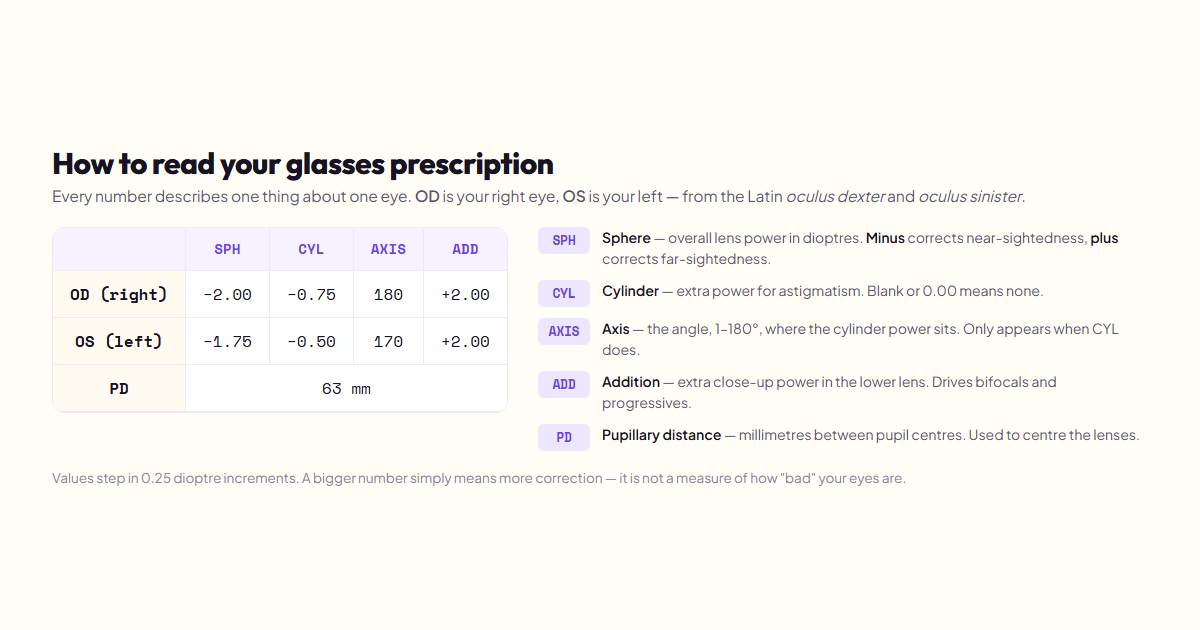
You've just had an eye exam and the optometrist hands you a prescription slip covered in numbers, abbreviations, and plus/minus signs. It looks like a secret code. OD: -2.50 / -0.75 x 180. What does any of this mean?
Understanding your glasses prescription isn't just academic curiosity — it helps you make informed decisions when choosing lenses, comparing prices, and understanding why certain frames or lens types are recommended. This guide breaks down every abbreviation and number on a typical prescription in plain language.
The Basics: OD and OS
Every glasses prescription starts with two lines — one for each eye:
- OD (Oculus Dexter) — your right eye
- OS (Oculus Sinister) — your left eye
Some prescriptions use "RE" (Right Eye) and "LE" (Left Eye) instead, which is more intuitive. Occasionally you'll see OU (Oculus Uterque), which means "both eyes" — this is used when a measurement applies equally to both.
Why Latin?
Medical prescriptions historically used Latin abbreviations. OD, OS, and OU survive from this tradition. Don't worry about memorizing them — just remember: OD = Right, OS = Left. Your optician at any optical shop can walk you through your specific prescription if the numbers are confusing.
SPH (Sphere): Your Main Prescription Power
SPH is the most important number on your prescription. It indicates how much lens power you need to correct your basic distance vision. The value is measured in diopters (D).
- Negative (-) SPH = nearsighted (myopia). You see nearby objects clearly but distant objects are blurry. Example: -2.50
- Positive (+) SPH = farsighted (hyperopia). Distant objects may be clearer than close-up objects. Example: +1.75
- 0.00 or "Plano" = no sphere correction needed (but you might still have astigmatism or need reading add power)
What the Numbers Mean in Practice
| SPH Value | Classification | What It Means |
|---|---|---|
| 0.00 to +/-0.75 | Very mild | Slight blur at distance or near; some people don't need correction |
| +/-1.00 to +/-3.00 | Mild to moderate | Noticeable blur without correction; standard lenses work well |
| +/-3.25 to +/-6.00 | Moderate to high | Significant visual impairment without correction; consider high-index lenses for thinner profiles |
| +/-6.25 and above | High | Strong correction needed; high-index (1.67 or 1.74) lenses strongly recommended |
The higher your SPH number, the thicker your lens edges will be (for minus/nearsighted) or lens centres (for plus/farsighted). This is why opticians recommend high-index lenses for stronger prescriptions — they use denser material to achieve the same correction in a thinner profile. Learn more in our guide to single-vision and high-index lenses, and ask your optician about lens index options for your prescription strength.
CYL (Cylinder): Astigmatism Correction
CYL measures the amount of astigmatism correction needed. Astigmatism means your cornea (or lens) is shaped more like a football than a basketball, causing light to focus at multiple points instead of one. Our guide to the AXIS value explains the partner number that goes with every CYL.
- CYL is always paired with an AXIS value
- It can be negative or positive (different notation conventions exist)
- If your prescription has no CYL value (or shows "SPH" in the CYL column), you don't have astigmatism that needs correcting
Common CYL values range from -0.25 to -3.00. Mild astigmatism (-0.25 to -0.75) may or may not be corrected depending on whether it causes noticeable symptoms. Higher values (-1.00 and above) almost always require correction for comfortable vision.
AXIS: Direction of Astigmatism
AXIS is a number between 1 and 180 that tells the lab how to orient the cylinder correction in the lens. Think of it like the angle on a protractor — it specifies exactly where on your cornea the astigmatism is located so the lens can be ground to correct it at the right angle.
- AXIS only appears when there is a CYL value
- An AXIS of 180 (or close to it) means horizontal astigmatism — the most common type
- An AXIS of 90 means vertical astigmatism
- An AXIS anywhere between means oblique astigmatism
You don't need to understand the exact angle — that's the optician's job. But knowing that AXIS tells the lens lab where to apply the CYL correction is useful for understanding why the measurement matters.
Sample Prescription Decoded
OD: -2.50 / -0.75 x 180 means: Right eye needs -2.50 diopters of sphere correction (nearsighted), -0.75 diopters of astigmatism correction, oriented at 180 degrees (horizontal). For a detailed walkthrough of the angle number, see our guide to what AXIS means.
ADD: Reading Addition Power
ADD (sometimes called "Near Add" or "NV") appears on prescriptions for people who need help with close-up vision — typically adults over 40 experiencing presbyopia, the natural age-related loss of near focusing ability.
- ADD is always a positive (+) value
- It is added to your distance prescription (SPH) to calculate the near-vision power
- Common ADD values range from +0.75 (early presbyopia) to +3.00 (advanced presbyopia)
- ADD is the same for both eyes in the vast majority of prescriptions
If your prescription includes an ADD value, you'll need either bifocal or progressive lenses — or separate reading glasses. Progressive lenses are the most popular option today because they provide a smooth transition from distance to near vision without the visible line of traditional bifocals.
PD: Pupillary Distance
PD is the distance in millimetres between the centres of your two pupils. It's not always printed on the prescription slip (optometrists are not required to include it in all provinces), but it's essential for making your glasses correctly.
- Average adult PD: 54mm to 74mm (most people fall between 58-68mm)
- Single PD: Total distance between both pupils (e.g., 64mm)
- Dual PD: Individual distance from each pupil to the centre of your nose (e.g., 31.5 / 32.5). This is more precise because most faces are slightly asymmetric
If your PD is measured incorrectly or your lenses are made with the wrong PD, the optical centres of the lenses won't align with your pupils. This causes eye strain, headaches, and blurred vision — even with the correct prescription. This is one of the key reasons having your glasses fitted by a professional optician matters. When you visit an optical shop for glasses, they'll measure your PD precisely as part of the fitting process.
Prism: Alignment Correction
Prism values appear on a minority of prescriptions — typically when someone has a binocular vision issue where the eyes don't align properly (strabismus or convergence insufficiency). Prism shifts the perceived position of an image to compensate for the misalignment.
- Prism is measured in prism diopters (PD or Δ)
- It includes a direction: BU (Base Up), BD (Base Down), BI (Base In), BO (Base Out)
- Most people never need prism correction
If your prescription includes prism values, your optician will need to carefully position the prism within the lens during fabrication. This is one of the more precise aspects of lens-making and is best handled by an experienced lab.
Putting It All Together: Reading a Full Prescription
Here's a complete example prescription with every element decoded:
| SPH | CYL | AXIS | ADD | Prism | |
|---|---|---|---|---|---|
| OD (Right) | -3.25 | -1.00 | 175 | +2.00 | — |
| OS (Left) | -2.75 | -0.50 | 010 | +2.00 | — |
PD: 63mm
What this tells us about this person:
- Nearsighted — Both eyes have negative SPH values (around -3.00), meaning they need moderate correction for distance vision
- Has astigmatism — Both eyes have CYL values. The right eye has more astigmatism (-1.00) than the left (-0.50)
- Needs reading help — The ADD of +2.00 indicates moderate presbyopia, typical for someone in their mid-50s
- Needs progressives or bifocals — The combination of distance correction (SPH) and reading addition (ADD) means they need multifocal lenses
- No prism needed — Eyes are aligning normally
Glasses Prescription vs. Contact Lens Prescription
A very common misconception: your glasses prescription and contact lens prescription are not the same thing. You cannot use one to order the other.
The differences exist because glasses sit about 12mm from your eye, while contact lenses sit directly on the cornea. This vertex distance changes the effective power of the lens. For prescriptions above +/-4.00, the difference between the glasses Rx and contact Rx can be significant.
Contact lens prescriptions also include:
- Base Curve (BC) — The curvature of the back of the contact lens, fitted to your cornea shape
- Diameter (DIA) — The size of the contact lens
- Brand/Type — Contact lens prescriptions are brand-specific because different lenses have different parameters
You need a separate contact lens fitting to get a contact lens prescription. This typically involves a trial pair to check comfort and vision before finalizing the Rx.
Tips for Managing Your Prescription
- Keep a copy. Take a photo of your prescription with your phone right after your exam. This ensures you always have it accessible if you need to order glasses or reference it later.
- Know the expiry. In most Canadian provinces, a glasses prescription is valid for 2 years. Mark the date in your calendar so you don't forget to schedule your next eye exam before it expires.
- Compare year-over-year. Track whether your prescription is stable or changing. Rapid changes can indicate underlying eye health issues worth discussing with your optometrist.
- Use your insurance wisely. Most insurance plans — including Alberta Blue Cross, Canada Life, and Desjardins — cover eye exams every 12-24 months and include an optical benefit for glasses. Time your exam to align with your benefit cycle for maximum coverage.
- Ask questions. If anything on your prescription is unclear, ask your optometrist or optician to explain it. A good eye care professional will take the time to make sure you understand your vision needs.
Online Ordering Caution
If you're ordering glasses online, you'll need to enter your prescription values accurately. Double-check every number, especially the plus/minus signs and the AXIS value. A transposed number can result in glasses that are completely wrong. When in doubt, bring your prescription to a local optical shop where a trained optician can verify the values and ensure your lenses are made correctly.
Decoded your prescription? Ready for new glasses?
Charm Optical in South Edmonton verifies your prescription values in person, fits the right lens index for your strength, and direct-bills most Alberta insurers.
Browse prescription glassesFrequently Asked Questions
SPH (Sphere) indicates the lens power to correct nearsightedness or farsightedness. A negative (-) value means nearsighted; a positive (+) value means farsighted. The number is measured in diopters — the higher the absolute number, the stronger the correction. Your optometrist determines this during a comprehensive eye exam.
PD (Pupillary Distance) is the distance in millimetres between the centres of your pupils. It's essential for positioning the optical centres of your lenses correctly. Average adult PD ranges from 54mm to 74mm. Your optician measures this when fitting your glasses.
AXIS (1-180 degrees) indicates the angle at which your astigmatism correction is oriented in the lens. It only appears when you have a CYL value. It tells the lab exactly how to position the cylinder correction to match the shape of your corneal astigmatism.
No — glasses and contact lens prescriptions are different. Contacts sit on your eye while glasses sit 12mm away, changing the effective power needed. Contact Rx also includes base curve and diameter. You need a separate contact lens fitting.
Most Canadian provinces allow glasses prescriptions for 2 years from the exam date. If your vision changes or you have symptoms before then, get a new exam sooner. Children's prescriptions are typically valid for 1 year. Many insurance providers cover exams every 1-2 years.
Sources & Further Reading
- American Academy of Ophthalmology — Prescriptions — How to read your eye prescription
- National Eye Institute — Refractive Errors — Myopia, hyperopia, and astigmatism explained
- Canadian Association of Optometrists — Understanding prescriptions in Canada
- Mayo Clinic — Refractive Errors — Medical overview of common refractive conditions