What a Glasses Prescription Looks Like
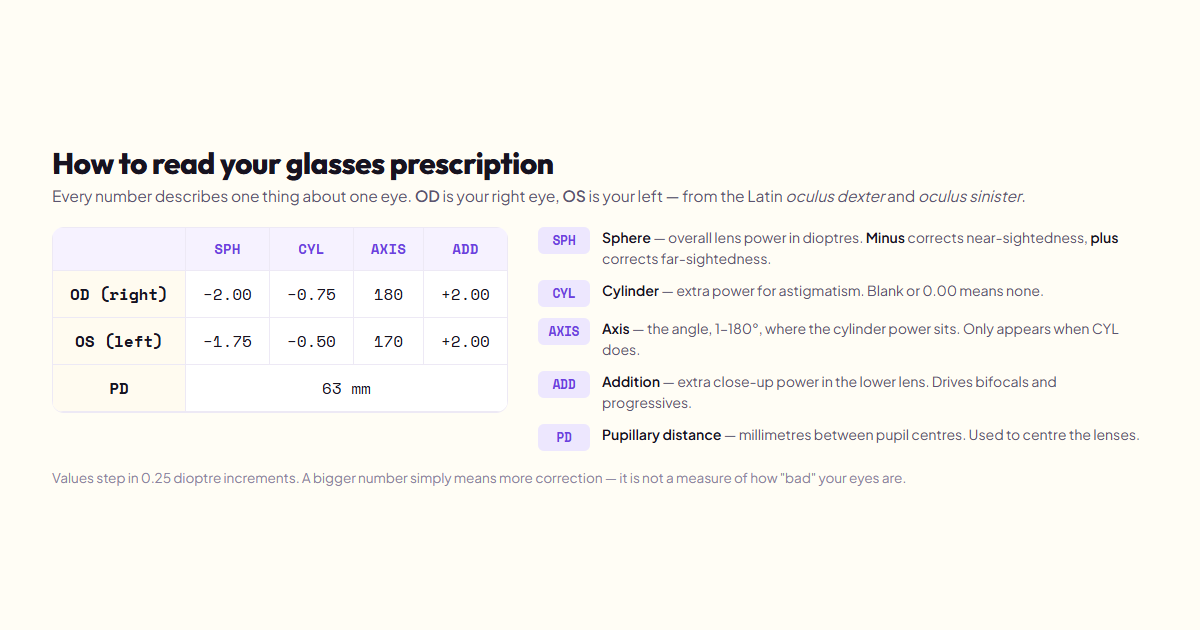
Here's a typical prescription:
OD (Right Eye): -2.50 / -0.75 x 180
OS (Left Eye): -3.00 / -1.00 x 175
ADD: +2.00
PD: 63mm
Looks like a secret code, but each number has a specific meaning. Let's break it down piece by piece.
This is one of the most common questions that comes up during eye exams, and the answer often depends on individual factors that only a professional assessment can evaluate. What works for one person may not be ideal for another — your prescription, daily activities, facial anatomy, and budget all play a role in determining the best approach.
If you're in the Edmonton area, Charm Optical offers comprehensive eye exams that go beyond just measuring your prescription. Their optometrists assess your overall eye health, discuss your visual needs, and recommend lens and frame options tailored to your lifestyle. With direct insurance billing for most Alberta providers and same-day glasses for many prescriptions, getting the right eyewear doesn't have to be complicated or expensive. Book online — appointments are usually available within a few days.
OD and OS: Right Eye and Left Eye
OD stands for "oculus dexter" (Latin for right eye). OS stands for "oculus sinister" (left eye). Some prescriptions use OU (oculus uterque) when a value applies to both eyes.
Your right eye and left eye almost always have different prescriptions. The brain combines the input from both, which is why the difference usually isn't noticeable to you — but the lens maker needs exact numbers for each eye.
This is one of the most common questions that comes up during eye exams, and the answer often depends on individual factors that only a professional assessment can evaluate. What works for one person may not be ideal for another — your prescription, daily activities, facial anatomy, and budget all play a role in determining the best approach.
If you're in the Edmonton area, Charm Optical offers comprehensive eye exams that go beyond just measuring your prescription. Their optometrists assess your overall eye health, discuss your visual needs, and recommend lens and frame options tailored to your lifestyle. With direct insurance billing for most Alberta providers and same-day glasses for many prescriptions, getting the right eyewear doesn't have to be complicated or expensive. Book online — appointments are usually available within a few days.
Sphere (SPH): Your Main Prescription Power
The sphere value is the primary correction for how your eye focuses light. It's measured in diopters (D).
Negative numbers (e.g., -2.50): You're nearsighted (myopic). You see near objects clearly but distant objects are blurry. The more negative the number, the stronger the prescription.
Positive numbers (e.g., +1.50): You're farsighted (hyperopic). Distance vision may be okay, but near objects are blurry. Higher positive numbers mean stronger correction needed.
What the numbers mean practically:
- -0.25 to -1.00: Mild myopia — you might not need glasses full-time
- -1.00 to -3.00: Moderate — glasses needed for driving and distance
- -3.00 to -6.00: Moderately high — glasses needed most of the time
- -6.00 and beyond: High myopia — full-time glasses or contacts needed
If your SPH is listed as "Plano" or "PL," it means zero correction — your eye doesn't need sphere correction (but you might still have astigmatism).
Cylinder (CYL) and Axis: Astigmatism Correction
If you have astigmatism, your prescription will include CYL and axis values. Astigmatism means your cornea or lens is shaped more like a football than a basketball — light focuses unevenly, causing blur at all distances.
CYL (Cylinder) measures how much astigmatism correction you need, in diopters. It can be negative or positive depending on the notation system your doctor uses.
Axis is a number from 1 to 180 that tells the lens maker the angle (in degrees) at which the cylindrical correction needs to be placed. Without the correct axis, the astigmatism correction would be aimed in the wrong direction.
Example: -0.75 x 180 means you need -0.75 diopters of astigmatism correction placed at the 180-degree axis (horizontal).
Mild astigmatism (under -0.75) is extremely common and may not need correction. Higher values make a more noticeable difference in visual clarity.
ADD Power: For Progressive and Bifocal Lenses
The ADD (addition) value appears on prescriptions for people who need progressive or bifocal lenses. It represents the extra magnifying power added to the bottom of the lens for reading and close-up tasks.
ADD is always a positive number, typically ranging from +0.75 to +3.00. It's the same for both eyes in most cases.
- +0.75 to +1.25: Early presbyopia — you're just starting to need reading help
- +1.50 to +2.00: Moderate presbyopia — the most common range
- +2.25 to +3.00: Advanced presbyopia — strong reading correction needed
If your prescription doesn't include an ADD value, you don't need multifocal lenses — single vision will work.
This is one of the most common questions that comes up during eye exams, and the answer often depends on individual factors that only a professional assessment can evaluate. What works for one person may not be ideal for another — your prescription, daily activities, facial anatomy, and budget all play a role in determining the best approach.
If you're in the Edmonton area, Charm Optical offers comprehensive eye exams that go beyond just measuring your prescription. Their optometrists assess your overall eye health, discuss your visual needs, and recommend lens and frame options tailored to your lifestyle. With direct insurance billing for most Alberta providers and same-day glasses for many prescriptions, getting the right eyewear doesn't have to be complicated or expensive. Book online — appointments are usually available within a few days.
Pupillary Distance (PD)
PD is the distance between the centres of your two pupils, measured in millimetres. Average adult PD ranges from 54 to 74mm, with most people falling between 58 and 68mm.
PD isn't technically part of your medical prescription — it's a measurement used by the lab to position the optical centre of each lens directly in front of your pupils. If PD is off by more than a couple of millimetres, you'll experience distortion, eye strain, and headaches.
Your optometrist may or may not include PD on your written prescription. If they don't, ask for it — especially if you plan to order glasses online. Any optician can measure your PD quickly at no charge.
Some prescriptions list two PD values (e.g., 31/32) — this is the monocular PD, measuring each eye's distance from the centre of your nose. This is more precise and preferred for progressive lenses. The team at Charm Optical takes both measurements during your exam.
Prism: When Your Eyes Don't Track Together
A small percentage of prescriptions include prism correction. Prism is needed when your eyes don't align properly, causing double vision or eye strain. The prism bends light to compensate for the misalignment.
Prism is measured in prism diopters (PD or Δ) and includes a base direction (Base Up, Base Down, Base In, or Base Out) that tells the lab which way to orient the prism.
Prism prescriptions are more complex and more expensive to fill. They absolutely need professional fitting — this is not something to order online without expert guidance.
This is one of the most common questions that comes up during eye exams, and the answer often depends on individual factors that only a professional assessment can evaluate. What works for one person may not be ideal for another — your prescription, daily activities, facial anatomy, and budget all play a role in determining the best approach.
If you're in the Edmonton area, Charm Optical offers comprehensive eye exams that go beyond just measuring your prescription. Their optometrists assess your overall eye health, discuss your visual needs, and recommend lens and frame options tailored to your lifestyle. With direct insurance billing for most Alberta providers and same-day glasses for many prescriptions, getting the right eyewear doesn't have to be complicated or expensive. Book online — appointments are usually available within a few days.
How Long Is a Glasses Prescription Valid?
In most Canadian provinces, a glasses prescription is valid for one to two years from the date of the exam. In Alberta, there's no legislated expiry period, but most optical stores follow the two-year standard, and your eyes can change within that time.
The Canadian Association of Optometrists recommends annual eye exams for adults over 65, people with diabetes, and those with known eye conditions. For healthy adults aged 20-64, exams every one to two years are recommended.
If your prescription is getting close to expiring, book an eye exam at Charm Optical to get updated numbers before ordering new glasses. An accurate prescription is the foundation of comfortable vision — no amount of premium lenses or coatings can compensate for wrong numbers.
This is one of the most common questions that comes up during eye exams, and the answer often depends on individual factors that only a professional assessment can evaluate. What works for one person may not be ideal for another — your prescription, daily activities, facial anatomy, and budget all play a role in determining the best approach.
If you're in the Edmonton area, Charm Optical offers comprehensive eye exams that go beyond just measuring your prescription. Their optometrists assess your overall eye health, discuss your visual needs, and recommend lens and frame options tailored to your lifestyle. With direct insurance billing for most Alberta providers and same-day glasses for many prescriptions, getting the right eyewear doesn't have to be complicated or expensive. Book online — appointments are usually available within a few days.
Your Prescription Is Yours — You Can Take It Anywhere
In Canada, your optometrist is legally required to give you a copy of your prescription after your exam. You can fill it at any optical store, chain, or online retailer you choose.
However, keep in mind that a prescription only tells part of the story. The measurements taken during lens fitting (fitting height for progressives, PD verification, frame wrap angle) are equally important for visual performance. That's why complex prescriptions — especially those with progressive ADD or prism — benefit from in-person fitting at a trusted optical store.
If you have questions about your prescription, bring it into Charm Optical and the team will walk you through every number. Understanding your Rx helps you make better decisions about your eyewear.
This is one of the most common questions that comes up during eye exams, and the answer often depends on individual factors that only a professional assessment can evaluate. What works for one person may not be ideal for another — your prescription, daily activities, facial anatomy, and budget all play a role in determining the best approach.
If you're in the Edmonton area, Charm Optical offers comprehensive eye exams that go beyond just measuring your prescription. Their optometrists assess your overall eye health, discuss your visual needs, and recommend lens and frame options tailored to your lifestyle. With direct insurance billing for most Alberta providers and same-day glasses for many prescriptions, getting the right eyewear doesn't have to be complicated or expensive. Book online — appointments are usually available within a few days.
Getting Your Prescription Right
Your glasses are only as good as your prescription. An outdated or inaccurate prescription means blurry vision no matter how expensive your lenses are. The Canadian Association of Optometrists recommends eye exams every 1-2 years for adults and annually for children, seniors, and anyone with diabetes or a family history of eye disease.
A comprehensive eye exam does far more than measure your prescription. Your optometrist checks the health of your retina, optic nerve, and blood vessels — catching conditions like glaucoma, macular degeneration, and diabetic retinopathy early, often before you notice any symptoms. They also measure your intraocular pressure, test your peripheral vision, and assess how your eyes work together as a team.
In Alberta, a comprehensive eye exam typically costs $100-$180 if not covered by insurance. Most employer plans cover the exam fee entirely. Children under 18 and adults over 65 receive coverage through Alberta Health. Charm Optical in Edmonton offers comprehensive eye exam at Charm Optical with experienced optometrists and direct-bills most direct insurance billing. book an eye exam online online — appointments are usually available within a few days.
Need Your Prescription Updated?
Charm Optical in South Edmonton offers comprehensive eye exams with thorough prescriptions. The team explains every number so you understand exactly what your eyes need.
Book Your Eye ExamFrequently Asked Questions
Sources & Further Reading
- College of Optometrists (UK) — Clinical guidance on prescribing standards
- American Academy of Ophthalmology — Understanding Prescriptions — How to read your eye prescription
- World Council of Optometry — Global standards for optometric practice
- Mayo Clinic — Refractive Errors — Medical overview of common refractive conditions