Astigmatism is one of the most common vision conditions in the world — yet it's also one of the most misunderstood. Many people who are told they have astigmatism worry it's a disease or a sign of deteriorating eye health. In reality, it's simply a variation in the shape of your eye that affects how light focuses, and it's easily corrected with the right glasses.
This guide explains what astigmatism actually is, how glasses correct it, what to expect when wearing astigmatism glasses for the first time, and when alternative treatments might be worth considering.
What Is Astigmatism, Exactly?
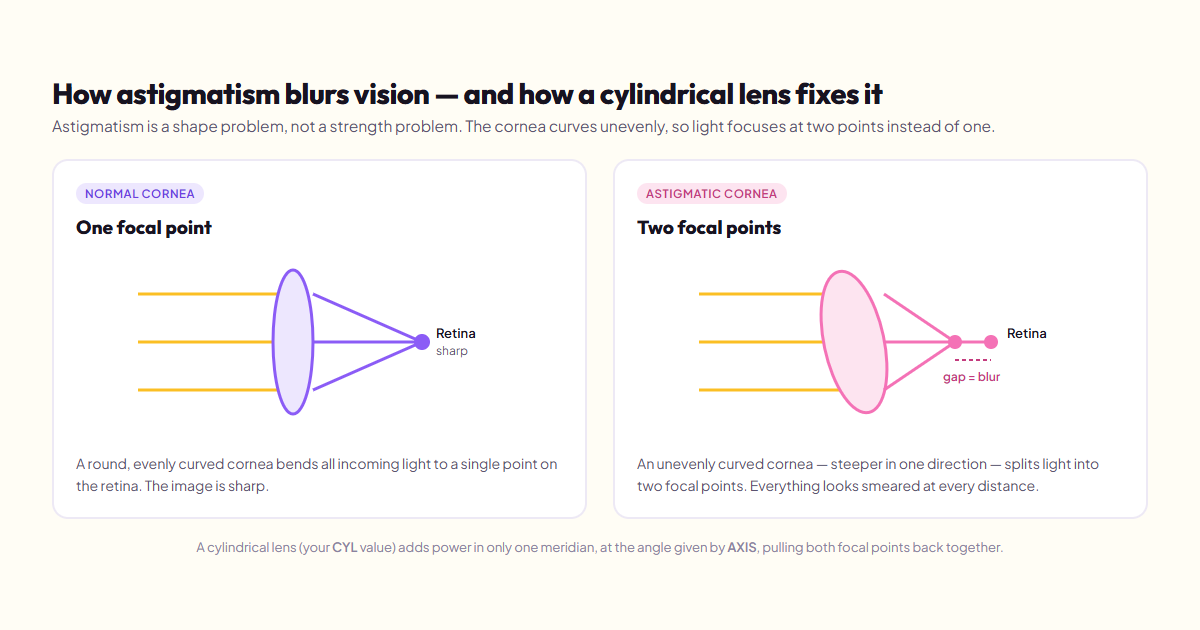
In a perfect eye, the cornea (the clear front surface) and the internal lens are both perfectly spherical — shaped like a basketball. Light enters the eye and focuses at a single point on the retina, producing a sharp image.
With astigmatism, the cornea (or less commonly, the internal lens) is shaped more like a football or an egg — curved more steeply in one direction than the other. This means light focuses at two different points instead of one, creating a blurred or distorted image at all distances.
How Common Is Astigmatism?
Very common. Studies suggest that roughly one in three people has some degree of astigmatism. Most cases are mild and may not even require correction. About 30-40% of people who wear glasses have astigmatism included in their prescription. It's not a disease — it's a normal anatomical variation, like having feet that are slightly different sizes. A comprehensive eye exam can detect and measure astigmatism precisely.
Types of Astigmatism
Not all astigmatism is the same. Understanding the type helps explain the prescription values you'll see:
Corneal vs. Lenticular
- Corneal astigmatism — The cornea itself is irregularly shaped. This is the most common type (roughly 95% of cases) and is easily corrected with glasses.
- Lenticular astigmatism — The internal crystalline lens of the eye is irregularly shaped. Less common and can sometimes change as the lens ages.
Regular vs. Irregular
- Regular astigmatism — The two principal meridians (steepest and flattest curves) are perpendicular to each other (90 degrees apart). This is what glasses correct well. The vast majority of astigmatism is regular.
- Irregular astigmatism — The meridians are not perpendicular, or the curvature is inconsistent across the surface. This can result from corneal scarring, keratoconus, or previous eye surgery. Irregular astigmatism is harder to correct with standard glasses and may require specialty or toric contact lenses for astigmatism.
By Orientation
| Type | AXIS on Prescription | Description | Prevalence |
|---|---|---|---|
| With-the-rule | Near 180 (or 0) | Steepest curvature is vertical | Most common in younger adults |
| Against-the-rule | Near 90 | Steepest curvature is horizontal | More common after age 40 |
| Oblique | Between 30-60 or 120-150 | Steepest curvature is diagonal | Less common |
Symptoms of Uncorrected Astigmatism
Mild astigmatism may cause no noticeable symptoms at all. But as the amount increases, or during visually demanding tasks, you might experience:
- Blurred vision at all distances — not just far away or up close, but both
- Eye strain and fatigue, especially after reading, screen work, or driving
- Headaches, particularly after prolonged visual tasks
- Difficulty with night driving — halos, starbursts, and streaking around headlights (your pupil dilates in low light, exposing more of the irregular cornea)
- Squinting — unconsciously narrowing your eyelids to try to sharpen focus
- Tilting your head — some people unconsciously tilt to find a clearer angle
If these symptoms sound familiar, schedule a comprehensive eye exam — astigmatism is one of the first things tested during a standard refraction. For a deeper look at the prescription numbers behind it, see our guide to the AXIS value and how to read your prescription.
How Glasses Correct Astigmatism
Glasses correct astigmatism using cylindrical lenses. Here's how it works:
A standard spherical lens (for myopia or hyperopia alone) has the same curvature in every direction — like the surface of a ball. It bends light equally from all angles. A cylindrical lens has a different curvature in one direction than the other — like the surface of a cylinder. It bends light more in one meridian and less in the perpendicular meridian.
When your prescription includes CYL (cylinder) and AXIS values, the lab grinds this cylindrical correction into the lens at the exact angle matching your astigmatism. The result: the two focal points that astigmatism creates are brought back together into one, producing a sharp, focused image.
What CYL and AXIS Mean on Your Prescription
- CYL (Cylinder) — The amount of astigmatism correction, measured in diopters. Common values range from -0.25 to -4.00. Higher numbers mean more astigmatism.
- AXIS — The angle (1-180 degrees) at which the cylinder correction is oriented. This must be precise — even a few degrees off can cause blurriness and discomfort.
Importantly, astigmatism correction in glasses looks no different from any other lens. You won't see the cylinder or feel it — the correction is ground into the lens surface during fabrication and is invisible.
Adapting to Astigmatism Glasses
If you're getting astigmatism correction in your glasses for the first time — or if your cylinder value has changed significantly — you may need a brief adaptation period. Here's what's normal:
First Few Days
- The floor may look tilted or warped — especially with oblique astigmatism corrections. Your brain is recalibrating to the new visual input.
- Peripheral distortion — Objects at the edges of your vision may appear slightly stretched or curved. This typically resolves within 1-2 weeks.
- Mild dizziness or "swimmy" feeling — The world looks different through cylinder correction, and your vestibular system may take a few days to adjust.
What's NOT Normal
- Persistent headaches after 2 weeks — This may indicate the prescription, PD, or optical centres need checking
- One eye significantly blurrier than the other — Could mean the lenses were made with incorrect values
- Nausea that doesn't improve — This is unusual and warrants a return visit to your optician
If adaptation symptoms don't resolve within 1-2 weeks of full-time wear, return to your optical shop for a verification. The optician can check that the lenses were made correctly and that the frame is properly aligned with your pupils.
Tip: Wear Them Full-Time
The most common reason for slow adaptation is inconsistent wear. If you only put on your new glasses occasionally, your brain never fully adjusts. Wear them consistently for 1-2 weeks — the adaptation period is much faster when your visual system gets uninterrupted exposure to the new correction.
Lens Options for Astigmatism
Astigmatism correction works with all standard lens types:
Single Vision
The simplest and most common option. One correction for distance or near vision, with the cylinder built in. Available at all optical shops, often with same-day availability for standard prescriptions.
Progressive Lenses
If you need correction for both distance and near vision (presbyopia + astigmatism), progressive lenses incorporate your cylinder correction throughout the entire lens. Modern digital progressives handle astigmatism very well — the cylinder is precisely calculated for every point on the lens, not just the optical centre.
High-Index Lenses
For higher astigmatism prescriptions (CYL above -2.00), the lens may be noticeably thicker in one meridian. High-index lens materials (1.67 or 1.74) reduce this thickness difference, making the lenses more cosmetically appealing and lighter. Ask your optician about high-index options when choosing your new frames.
Blue Light and Coated Lenses
All lens coatings — anti-reflective, blue light filtering, photochromic — are fully compatible with astigmatism correction. The coatings are applied on top of the cylinder correction and don't interfere with it.
Glasses vs. Contacts for Astigmatism
Both glasses and contacts can correct astigmatism, but they work differently:
| Factor | Glasses | Toric Contacts |
|---|---|---|
| Correction quality | Excellent for regular astigmatism of any amount | Very good, but lens rotation can cause momentary blur |
| Adaptation | 1-2 weeks for new Rx | Usually immediate, but fitting process takes longer |
| Cost | No extra charge for CYL in lenses | Toric contacts cost 20-50% more than spherical |
| Convenience | Easy on/off, no maintenance | Requires cleaning/replacement schedule |
| Peripheral vision | Limited by frame; some barrel distortion | Full peripheral correction |
| Sports/active use | Can slip, fog, or break | Better for sports and physical activity |
Many people with astigmatism use both — glasses for everyday wear and toric contact lenses for sports, special occasions, or days when they prefer not to wear frames. Your eye care professional can prescribe both and help you decide which situations suit each option.
Can Astigmatism Be Cured?
Glasses and contacts correct astigmatism — they compensate for the irregular corneal shape while you're wearing them. They don't change the shape of your eye. When you take them off, the astigmatism is still there.
Permanent correction options exist but are more involved:
- LASIK / PRK — Laser eye surgery can reshape the cornea to correct astigmatism permanently. Most candidates need a stable prescription for 1-2 years before surgery. Success rates for mild to moderate astigmatism are very high.
- Toric IOLs — For people having cataract surgery, toric intraocular lenses can correct astigmatism at the same time as the cataract is removed.
- Orthokeratology (Ortho-K) — Rigid contact lenses worn overnight temporarily reshape the cornea so you don't need correction during the day. The effect is reversible — stop wearing the lenses and the cornea returns to its original shape.
For most people, glasses remain the safest, most cost-effective, and most convenient way to manage astigmatism. Surgery is an option for those who are good candidates, but it's not necessary — astigmatism is not a progressive disease in most cases.
Astigmatism in Children
Astigmatism is often present from birth and is frequently detected during early childhood eye exams. In children, uncorrected astigmatism is particularly concerning because it can lead to amblyopia (lazy eye) if one eye has significantly more astigmatism than the other and the brain begins to suppress the blurrier image.
The Canadian Association of Optometrists recommends that children have their first comprehensive eye exam between 6 and 9 months of age, with follow-ups at age 2-5 and annually after starting school. Children's vision care — including astigmatism monitoring — is an important part of ensuring healthy visual development.
If your child has been prescribed glasses for astigmatism, consistent wear is important. Unlike adults, children's visual systems are still developing, and consistent correction helps the brain learn to process sharp images from both eyes.
Living with Astigmatism: Practical Tips
- Keep your prescription current. Astigmatism can change gradually, especially during childhood and after age 40. An annual eye exam ensures your correction stays accurate.
- Choose frames with good optical alignment. For higher astigmatism corrections, frame fit matters more — the optical centres must align precisely with your pupils. A professional fitting at a trusted optical shop makes a significant difference.
- Consider anti-reflective coating. AR coating is especially beneficial for astigmatism glasses because it reduces ghost images and internal reflections that cylinder lenses can create.
- Know your insurance coverage. Astigmatism correction in glasses is standard and covered by all optical insurance benefits. Plans from Alberta Blue Cross, Canada Life, and Desjardins all cover prescription lenses that include cylinder correction — there's no "astigmatism surcharge" for glasses. Check your insurance provider's details for specific coverage amounts.
Need astigmatism glasses or toric contacts?
Charm Optical in South Edmonton fits cylindrical lenses precisely, offers high-index options for stronger corrections, fits toric contact lenses, and direct-bills most Alberta insurers.
Browse glasses in EdmontonFrequently Asked Questions
Yes, glasses are the most common and effective correction for astigmatism. Cylindrical lenses compensate for the irregular shape of your cornea, bringing light to a single focus point. The correction is built into your prescription lenses (CYL and AXIS values) and works while you're wearing them. For a detailed explanation, see this comprehensive astigmatism guide.
No — astigmatism glasses look identical to any other prescription glasses. The correction is ground into the lens and is invisible. You can choose any frame style you like. For high corrections, high-index lenses keep the lens thin and cosmetically appealing.
Not wearing glasses does not cause astigmatism to worsen — it's determined by the physical shape of your cornea. However, uncorrected astigmatism causes eye strain, headaches, and fatigue. While the condition won't progress, you'll feel worse without correction.
Yes. Astigmatism correction (CYL and AXIS) is a standard part of prescription lens fabrication. There's typically no additional cost for astigmatism in glasses — it's included in the base lens price. Your insurance optical benefit covers lenses with astigmatism correction the same as any other prescription.
Yes, toric contact lenses are designed specifically for astigmatism. They have different powers in different meridians and are weighted to maintain correct orientation on your eye. You need a separate contact lens prescription and fitting — the values differ from your glasses Rx.
Sources & Further Reading
- National Eye Institute — Eye Conditions — Comprehensive eye disease database
- Mayo Clinic — Eye Diseases — Medical guidance on eye conditions
- American Academy of Ophthalmology — Eye Health A-Z — Peer-reviewed disease information
- Canadian Ophthalmological Society — Canadian eye disease prevention resources
- National Eye Institute — Astigmatism — NIH guide to astigmatism causes and correction