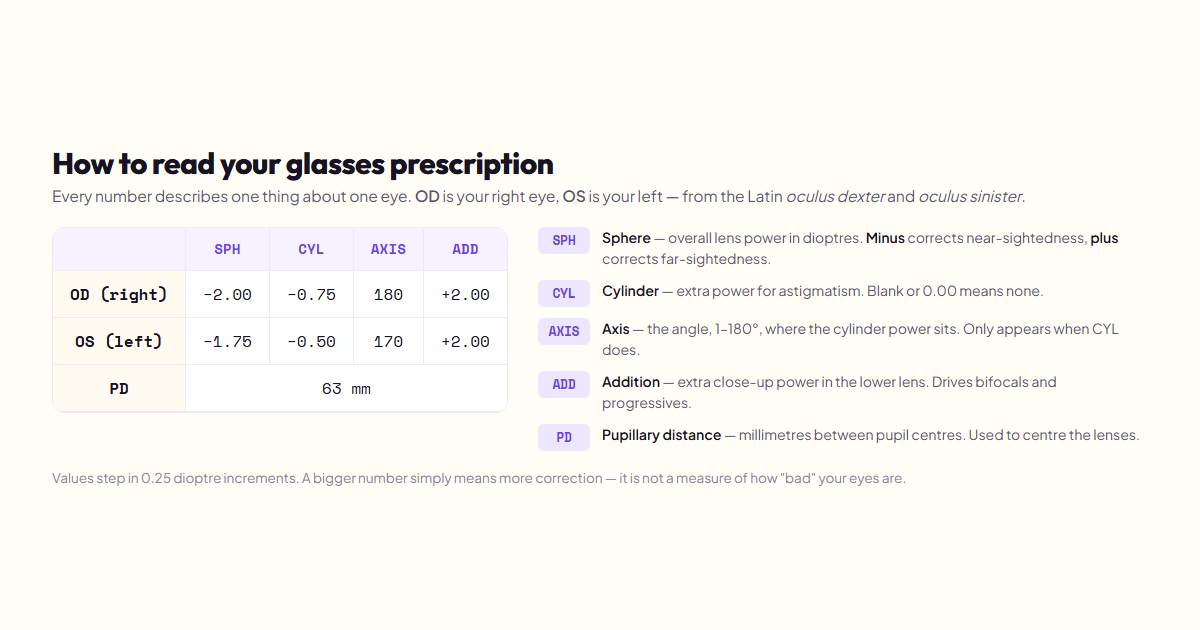
If you have ever tried to order glasses online, you have probably been asked for your "PD" and had no idea what it was. Or maybe you looked at your prescription, found values for sphere, cylinder, and axis, but saw no mention of PD anywhere. You are not alone — pupillary distance is one of the most important measurements for getting glasses that work correctly, yet it is one of the least explained.
This guide covers everything about PD: what it is, why it matters more than most people realize, how to measure it at home, and what happens when it is wrong.
What Is Pupillary Distance?
Pupillary distance (PD) is the distance in millimetres between the centres of your two pupils — the black circles in the middle of your eyes. This measurement tells the optical lab exactly where to position the optical centre of each lens so that it aligns with where you actually look through the lens.
The average adult PD falls between 54mm and 74mm, with 63mm being the overall average. Women tend to have slightly smaller PDs (58-65mm on average) and men slightly larger (61-68mm).
Single PD vs. Dual PD
Single PD (also called binocular PD) is the total distance between both pupils — for example, 64mm. Dual PD (also called monocular PD) is measured from the centre of each pupil to the bridge of the nose — for example, 31.5/32.5. Dual PD is more accurate because most people's faces are not perfectly symmetrical. Your right PD and left PD may differ by 1-2mm.
Why PD Matters for Your Glasses
Every prescription lens has an optical centre — the point where the lens provides the exact correction prescribed by your optometrist. When you look straight ahead, your pupils should be aligned with these optical centres.
If your PD measurement is inaccurate and the optical centres are placed too far apart, too close together, or off to one side, you are looking through an off-centre part of the lens. This introduces an effect called prismatic error — the lens bends light in a direction it should not, forcing your eye muscles to compensate.
The consequences of an incorrect PD depend on the size of the error and the strength of your prescription:
| PD Error | Mild Prescription (+/- 2.00) | Strong Prescription (+/- 6.00) |
|---|---|---|
| 1mm off | Usually unnoticeable | Mild discomfort possible |
| 2mm off | Possible mild strain | Headaches, eye fatigue |
| 3-4mm off | Noticeable eye strain | Significant discomfort, nausea, blurred vision |
| 5mm+ off | Headaches, difficulty focusing | Unusable glasses |
For progressive lenses, PD accuracy is even more critical. Progressives have distinct zones for distance, intermediate, and reading — and these zones are narrow. Even a 2mm PD error can shift the reading zone out of alignment, making the glasses feel wrong at every distance.
Why PD Is Not Always on Your Prescription
In Canada and many other countries, PD is considered a fitting measurement rather than a medical value. Your eye prescription (sphere, cylinder, axis, add power) describes what your eyes need optically. PD describes where to position that correction in the frame you choose.
Because PD is frame-dependent (the same person might need slightly different PD positioning for a wide frame versus a narrow one), many optometrists leave it to the dispensing optician to measure at the time of fitting. This is not them withholding information — it is a division of responsibility.
However, you have the right to ask for your PD. If you request it during your eye exam, most optometrists will include it on your prescription. Alternatively, any optical store can measure your PD when you come in to order glasses.
How to Measure Your PD at Home
If you need your PD for an online order or want to verify the number on your prescription, you can measure it at home. The most reliable method uses a millimetre ruler and a mirror.
The Mirror Method (Most Accurate)
- Stand approximately 20 cm (8 inches) from a well-lit mirror.
- Hold a millimetre ruler flat against your brow, just above your eyes. The ruler should be horizontal and level.
- Close your right eye. With your left eye, align the zero mark (0mm) of the ruler with the centre of your left pupil.
- Without moving the ruler, close your left eye and open your right eye.
- Read the millimetre mark that aligns with the centre of your right pupil. This number is your PD.
- Repeat the process 3-4 times. If your readings vary by more than 1mm, average them.
The Friend Method
Having someone else measure your PD can be more accurate because they can see both pupils simultaneously. The process:
- Sit facing each other at arm's length.
- Look straight ahead at a distant object (not at the person measuring).
- Your helper holds the ruler across your brow and reads the distance from the centre of your left pupil to the centre of your right pupil.
- Repeat 3 times and average.
Smartphone Apps
Several smartphone apps use the front-facing camera and a reference object (usually a credit card held against your face) to calculate PD. These can be convenient, but their accuracy varies. In testing, most apps are accurate within 1-2mm — acceptable for single-vision lenses with mild prescriptions, but not precise enough for strong prescriptions or progressive lenses.
For Progressive Lenses: Get a Professional Measurement
If you are ordering progressive lenses, monocular PD is essential — and it is very difficult to measure at home with sufficient accuracy. A licensed optician using a pupilometer (a specialized device that measures PD digitally) gives results accurate to 0.5mm, which makes a meaningful difference in progressive lens comfort.
Measuring Monocular PD (Dual PD)
Monocular PD measures the distance from each pupil to the centre of the nose bridge, giving you two numbers (e.g., 31/32.5). This is more accurate than a single number because most faces are slightly asymmetrical.
To measure monocular PD at home:
- Using the mirror method, align the zero mark with the centre of your right pupil.
- Read the measurement at the centre of your nose bridge (the midpoint between your eyes). This is your right monocular PD.
- Repeat for the left side: zero on the left pupil, read at the centre of the nose bridge.
- The two numbers added together should equal your total (binocular) PD, plus or minus 1mm.
PD for Different Lens Types
Single-Vision Distance Lenses
Standard distance PD is measured while looking at a far point (6+ metres). This is the "default" PD that most prescriptions refer to. A tolerance of 1-2mm is generally acceptable for mild to moderate prescriptions.
Single-Vision Reading Lenses
When your eyes converge to read something close (30-40 cm), your pupils move slightly inward. Near PD is typically 3-4mm less than distance PD. If you are ordering dedicated reading glasses, use near PD. If your prescription does not specify it, subtract 3mm from your distance PD as a reasonable estimate.
Progressive Lenses
Progressives require the most precise PD measurement — preferably monocular, measured by a professional. The fitting also requires the segment height (the vertical position of the optical centre relative to the frame), which can only be measured while wearing the specific frame you have chosen. This is why in-person fitting at an optical store is strongly recommended for progressives.
Bifocal Lenses
Bifocals need both distance PD and segment height, though they are slightly more forgiving of minor errors than progressives because the focal zones are larger and have a clear dividing line rather than a gradient.
Common PD Myths
"My PD changes as I age"
For adults, PD is essentially fixed. Your skull stops growing by age 19-20, and PD stabilizes at that point. Children's PD does increase as they grow — which is why paediatric glasses fittings include PD measurement and regular updates.
"PD does not matter for mild prescriptions"
While it is true that the effects of PD error are smaller with weak prescriptions, they are not zero. Even at +/- 1.00, a 4mm PD error introduces enough prismatic effect to cause eye fatigue over a full day. Getting PD right costs nothing and prevents unnecessary strain.
"Online PD measurements are just as good"
For single-vision glasses with mild prescriptions, a careful home measurement is usually adequate. For progressive lenses, high prescriptions, or anyone who has experienced discomfort with previous glasses, a professional measurement with a digital pupilometer is worth the trip to an optical store.
What to Do If Your Glasses Feel Wrong
If you have new glasses and experience headaches, eye fatigue, blurred edges, or a "pulling" sensation, PD error is one of the first things to check. Bring your glasses back to where you purchased them and ask the optician to verify the PD alignment using a lensometer (a device that reads where the optical centre of the lens actually is).
If the optical centres do not match your measured PD, the lenses need to be remade. Reputable optical stores will redo lenses at no charge if the PD was set incorrectly. Stores with same-day lens service can typically resolve this within hours.
If PD is correct but the glasses still feel wrong, other factors may be at play: incorrect prescription, wrong segment height (for progressives), frame misalignment, or simply an adjustment period for first-time progressive wearers. A follow-up with your optometrist can help identify the cause.
PD and Online Glasses Shopping
If you are ordering glasses online, PD is one of the required fields. Here are practical tips:
- Always use a real PD measurement — never guess or use the "average" (63mm). The difference between your actual PD and the average could be 5mm or more.
- Measure at least 3 times and average the results.
- For progressives, strongly consider ordering in person. Progressive lenses require both PD and segment height measured with the specific frame you choose. Getting this wrong results in glasses that are uncomfortable or unusable. An in-person fitting is the most reliable way to get progressives right the first time.
- Keep your PD on file. Once you have an accurate measurement, it will not change (for adults). Write it on your prescription card or store it in your phone for future orders.
For the best combination of accurate measurement and wide selection, visiting a local optical store lets you get professionally measured PD while choosing from frames by Ray-Ban, Prada, Tom Ford, and other brands — all fitted and verified before you leave.
The Bottom Line
PD is a small number with a big impact. It determines whether the optical correction in your lenses actually reaches your eyes where it is supposed to. For single-vision glasses with mild prescriptions, a careful home measurement is adequate. For progressive lenses, strong prescriptions, or anyone who has had issues with glasses comfort in the past, a professional measurement is worth the effort.
If your prescription does not include PD, do not worry — any optical store can measure it in seconds. And if your current glasses are causing unexplained headaches or eye strain, an incorrect PD is one of the most common and easily fixable causes. Affordable glasses with an accurate PD will always outperform expensive glasses with a wrong one.
Frequently Asked Questions
PD stands for pupillary distance — the distance in millimetres between the centres of your two pupils. It is used to align the optical centre of each lens with your eyes when making prescription glasses. A typical adult PD ranges from 54mm to 74mm. Your optometrist or optician can measure this during an eye exam or glasses fitting.
Stand in front of a mirror, hold a millimetre ruler flat against your brow, close your right eye, align the zero mark with the centre of your left pupil, then without moving the ruler, close your left eye and open your right eye. Read the number at the centre of your right pupil. Repeat 3 times and average the results for best accuracy.
In Canada, PD is classified as a fitting measurement rather than a medical prescription value. Optometrists may not routinely include it. You can request it during your eye exam, or have it measured at any optical store when ordering glasses.
An incorrect PD forces your eyes to look through an off-centre part of the lens, creating prismatic error. This can cause eye strain, headaches, blurred vision, and difficulty with depth perception. The stronger your prescription, the more significant the effect. If your glasses feel wrong, ask your optician to verify the PD alignment.
Adult PD is essentially fixed by age 19-20 and does not change with age. Children's PD increases as they grow, so paediatric fittings require regular PD updates. Even though adult PD is stable, it should be measured with each new pair of glasses to ensure the previous measurement was accurate.
Sources & Further Reading
- American Academy of Ophthalmology — Prescriptions — How to read your eye prescription
- National Eye Institute — Refractive Errors — Myopia, hyperopia, and astigmatism explained
- Canadian Association of Optometrists — Understanding prescriptions in Canada
- Mayo Clinic — Refractive Errors — Medical overview of common refractive conditions