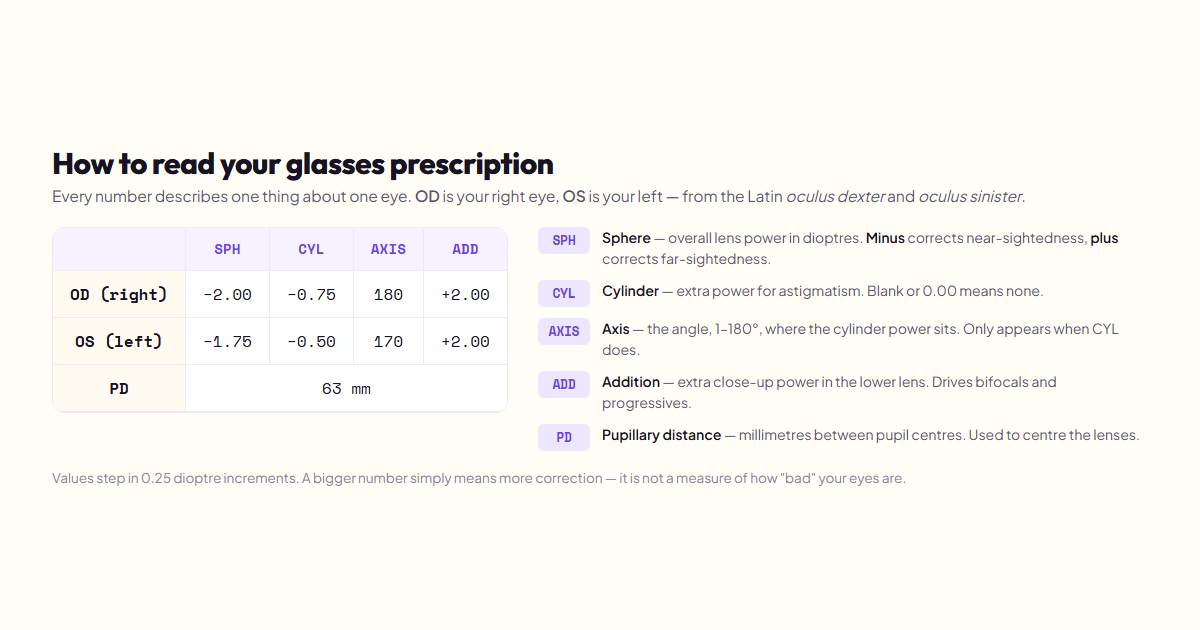
You've just had an eye exam and you're looking at your prescription. SPH, CYL, AXIS — the numbers look like coordinates on a treasure map. The SPH (sphere) part is fairly intuitive: it tells you whether you're nearsighted or farsighted and by how much. But what about that AXIS number? Why does it say "175" or "090" and what happens if it's wrong?
This guide explains every value on your prescription in plain language, with a focus on the AXIS — the most misunderstood number on the slip.
Your Prescription: The Big Picture
Before diving into AXIS specifically, let's map out the whole prescription. Understanding how the values relate to each other makes the AXIS much easier to grasp.
A typical eyeglass prescription looks something like this:
| Eye | SPH | CYL | AXIS | ADD |
|---|---|---|---|---|
| OD (Right) | -2.50 | -0.75 | 180 | |
| OS (Left) | -3.00 | -1.25 | 015 |
Each value controls a specific aspect of your lens. Here's what they do:
- OD / OS — Right eye (oculus dexter) and left eye (oculus sinister). Each eye gets its own prescription because they almost never have identical refractive errors.
- SPH (Sphere) — The main corrective power, measured in diopters. A negative number corrects myopia (nearsightedness); a positive number corrects hyperopia (farsightedness).
- CYL (Cylinder) — Additional power to correct astigmatism. If this box is empty, you don't have astigmatism (or it's too minor to correct).
- AXIS — The angle at which the CYL correction is oriented. Only present when there is a CYL value.
- ADD — Additional magnification for reading, used in bifocals and progressive and single-vision lenses.
For the full breakdown of how to read every number on your prescription, see our detailed guide on how to read your glasses prescription. If you also want to understand the pupillary-distance measurement, our what is PD guide explains why that number matters for astigmatism.
What Is Astigmatism?
To understand AXIS, you need to understand the problem it solves: astigmatism.
In a perfect eye, the cornea (the clear front surface) is shaped like a basketball — evenly curved in all directions. Light entering the eye converges to a single focal point on the retina, and you see clearly.
In an eye with astigmatism, the cornea is shaped more like a football (or a rugby ball). It has a steeper curve along one meridian and a flatter curve along the perpendicular meridian. This means light focuses at two different points instead of one, causing blurry or distorted vision at all distances.
How Common Is Astigmatism?
Extremely common. Studies estimate that about 30-40% of the population has astigmatism significant enough to require correction. Most people with astigmatism also have myopia or hyperopia, so their prescription includes both SPH and CYL/AXIS values.
What AXIS Actually Measures
AXIS measures the angle of orientation for the cylindrical (astigmatism) correction, expressed in degrees from 1 to 180. It tells the optician how to rotate the cylinder so it lines up with the steepest meridian of your cornea, following a specific standard:
- AXIS 180 — The correction is oriented horizontally (the cylinder power runs along the horizontal plane of the lens).
- AXIS 090 — The correction is oriented vertically.
- AXIS 045 or 135 — The correction is oriented diagonally (oblique astigmatism).
Think of looking at a clock face. AXIS 180 is the 3 o'clock to 9 o'clock line. AXIS 090 is the 12 o'clock to 6 o'clock line. Any angle in between is also possible — your astigmatism can be oriented at any degree from 1 to 180.
Why Only 1-180 and Not 1-360?
Because a cylinder lens is symmetrical. An axis of 10 degrees produces the same optical effect as 190 degrees — they describe the same line through the lens, just measured from opposite ends. So the standard convention uses only half the circle: 1 to 180.
The Relationship Between CYL and AXIS
CYL and AXIS always appear together. You will never see an AXIS value without a CYL value, because the axis is meaningless without a cylinder power to orient.
- CYL answers the question: "How much astigmatism correction do you need?" It's measured in diopters (e.g., -0.75, -1.50, -2.25).
- AXIS answers the question: "In which direction should that correction be applied?" It's measured in degrees (e.g., 015, 090, 180).
A prescription of CYL -1.25 AXIS 090 means: "This eye needs 1.25 diopters of cylindrical correction, oriented at 90 degrees (vertically)." The optician will cut and rotate the cylindrical lens so its corrective power aligns precisely with that angle.
Types of Astigmatism by Axis
Eye care professionals classify astigmatism based on the axis orientation:
| Type | Axis Range | Description | Prevalence |
|---|---|---|---|
| With-the-rule (WTR) | AXIS near 180 (or 1-15, 165-180) | Steeper curvature along the vertical meridian | Most common in younger adults |
| Against-the-rule (ATR) | AXIS near 090 (75-105) | Steeper curvature along the horizontal meridian | More common in older adults |
| Oblique | AXIS 016-074 or 106-164 | Steeper curvature along a diagonal | Least common |
Interestingly, with-the-rule astigmatism tends to shift toward against-the-rule with age. This is one reason your AXIS value can change over time and why regular eye exams are important — a prescription from three years ago may have a significantly different axis than what you need today.
What Happens If AXIS Is Wrong?
The AXIS is one of the most sensitive values on your prescription. Research published in Optometry and Vision Science has shown that even a 5-10 degree error in axis orientation can noticeably reduce visual acuity for people with moderate to high astigmatism.
Symptoms of an incorrect axis include:
- Blurry vision that doesn't clear up even after an adjustment period
- Headaches, especially around the eyes or temples
- Eye strain and fatigue
- Slight tilting or distortion of images
- Difficulty with depth perception
If you've recently gotten new glasses and something feels persistently off, the axis may be the culprit. Return to your optician — they can verify the axis of your current lenses with a lensometer and compare it to what's written on your prescription. A reputable optical shop will remake the lenses at no charge if there's a manufacturing error.
AXIS in Contact Lenses vs. Glasses
If you wear contact lenses for astigmatism (called toric contacts), the AXIS value is equally critical — but fitting is more complex because the lens sits on your eye and can rotate.
Toric contact lenses have built-in features to prevent rotation:
- Prism ballast — The lens is slightly thicker at the bottom, using gravity to keep it oriented correctly.
- Dual thin zones — Thin areas at the top and bottom that the eyelids compress during blinks, maintaining alignment.
- Truncation — The bottom edge is cut flat to stabilize against the lower eyelid.
Despite these features, toric contacts may rotate slightly throughout the day. An optometrist will evaluate the rotation during a toric contact lens fitting and adjust the prescribed axis to compensate (a technique called LARS — Left Add, Right Subtract). In Edmonton, Charm Optical fits toric contact lenses for astigmatism so the axis stays aligned on the eye.
How to Read Your Prescription Correctly
Here are some practical tips for understanding your prescription values:
- SPH with no CYL/AXIS — You have myopia or hyperopia but no significant astigmatism. Your lenses are spherical (same power in all directions).
- SPH with CYL and AXIS — You have a refractive error plus astigmatism. Your lenses combine spherical and cylindrical correction.
- "Plano" or "PL" in SPH — Your sphere power is zero. If you still have a CYL/AXIS value, you only have astigmatism without myopia or hyperopia.
- Negative vs. positive CYL — Optometrists in Canada typically write CYL as a minus value. Opticians may convert to plus cylinder for manufacturing. Both describe the same lens — just from different reference points.
Minus Cylinder vs. Plus Cylinder
If you compare your prescription from two different eye doctors and the CYL and AXIS values look completely different, don't panic. One may be using minus cylinder notation and the other plus cylinder. They can be converted mathematically and result in the same lens. Ask your optician to verify if you're unsure.
Can Astigmatism Be Fixed Permanently?
Glasses and contact lenses correct astigmatism while you wear them, but they don't change the underlying shape of your cornea. Permanent correction options include:
- LASIK / PRK — Laser eye surgery can reshape the cornea to correct astigmatism, often combined with myopia or hyperopia correction. Not suitable for everyone; requires stable vision and healthy corneas.
- Toric IOL — During cataract surgery, an astigmatism-correcting intraocular lens can be implanted, addressing both the cataract and the astigmatism.
- Orthokeratology — Specially designed rigid contact lenses worn overnight that temporarily reshape the cornea. Sometimes used as part of myopia control programs.
For most people, glasses remain the safest, most accessible, and most cost-effective solution for astigmatism. If you have insurance coverage for eyewear, the out-of-pocket cost for astigmatism-correcting lenses is often minimal — providers like Alberta Blue Cross and Desjardins optical coverage typically cover prescription lenses as part of their annual optical benefit, and clinics that direct-bill these insurers reduce your upfront cost.
Getting Your Prescription Filled
When you bring your prescription to an optical shop, the optician uses three key measurements to make your lenses:
- Your prescription values — SPH, CYL, AXIS, and ADD determine the optical power of each lens.
- Your pupillary distance (PD) — Ensures the optical centres align with your pupils. Especially critical for astigmatism because the axis must be centred correctly.
- Your frame measurements — Frame size, bridge width, and temple length affect how the lens sits in front of your eye.
For astigmatism in particular, having your lenses made by a skilled optician makes a real difference. The axis alignment needs to be precise, and the optical centre needs to match your PD exactly. This is one area where the expertise of an in-person optical shop — where they can measure, fit, and adjust — offers a genuine advantage over ordering online, especially for higher CYL values.
Many optical stores offer same-day glasses for common single-vision prescriptions including astigmatism correction, so you don't need to wait days for your lenses. This is one advantage of an in-person optical shop over ordering online, especially when the axis must be fitted precisely.
Astigmatism prescription to fill?
Charm Optical in South Edmonton fits astigmatism lenses precisely, offers same-day single-vision glasses, fits toric contact lenses, and direct-bills most Alberta insurers.
See same-day glasses in EdmontonFrequently Asked Questions
The axis is a number between 1 and 180 that describes the angle (in degrees) at which astigmatism correction is applied. It tells the optician how to orient the cylindrical lens so it corrects the specific meridian of your cornea that is irregularly shaped. The axis alone doesn't indicate how much correction you need — that's the CYL value.
Yes, the axis number is critical. Even a small error in axis orientation — as little as 5-10 degrees — can cause blurry vision, headaches, and eye strain. This is why a comprehensive eye exam and precise lens fitting by a licensed optician are important for anyone with astigmatism.
CYL (cylinder) measures the amount of astigmatism correction needed, in diopters. The axis measures the angle at which that correction is applied. Think of CYL as "how much" and axis as "in which direction." You will never have an axis without a CYL value, because the axis only has meaning when there is cylindrical correction to orient.
Yes, your axis can shift over time, though it typically changes slowly. Significant axis changes are more common in conditions like keratoconus. Regular eye exams every 1-2 years ensure your prescription stays current and your lenses are oriented correctly.
An axis of 180 means the astigmatism correction is oriented horizontally across the lens. This is the most common axis value, indicating that the steeper curvature of your cornea is along the vertical meridian (called "with-the-rule" astigmatism). Axis 90, by contrast, means the correction is oriented vertically ("against-the-rule" astigmatism).
Sources & Further Reading
- American Academy of Ophthalmology — Prescriptions — How to read your eye prescription
- National Eye Institute — Refractive Errors — Myopia, hyperopia, and astigmatism explained
- Canadian Association of Optometrists — Understanding prescriptions in Canada
- Mayo Clinic — Refractive Errors — Medical overview of common refractive conditions